

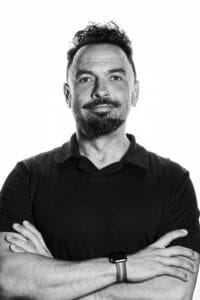
My Story
The common thread in everything I do is the search for essence — in a team, a piece of art, a system, or a person. Including myself.
My name is Dennis Khalil. I am a Multipotentialite. Dutch-Egyptian. Based in ’s-Hertogenbosch. I operate at the intersection of logic and intuition, using the friction between these worlds to build strategies, create art, and force breakthroughs.
People often ask me to define myself — am I a Fractional CIO, a conceptual artist, or a commercial photographer? The answer is all of them, and none of them exclusively. I have always seen things differently than the room I was in. Over time I stopped seeing that as a problem.
The Foundation: A Duality of Heritage
My approach is rooted in a creative tension I was born into. The analytical precision and structure of my Dutch upbringing. The symbolic, cyclical depth of my Egyptian roots.
For a long time, the corporate world told me these were opposing forces. They are not. They are the engine of my work. This duality allows me to look at a complex IT infrastructure and see the human behaviour driving it — or to look at a conceptual art piece and meticulously structure its creation process.
Chapter 1 — The Spark: A Photographer’s Eye
My creative journey did not begin in a classroom. It started with an analogue Kodak camera at the age of twelve.
I taught myself to shoot across every genre — from the raw energy of sports events to the quiet intimacy of portrait work. Over the years, I learned not just the technical craft, but how to see. How to read light, space, and the moment before the moment.
Photography taught me that observation is a discipline, not a talent. The person who looks more carefully than everyone else in the room is the person who finds what everyone else missed. I have been looking for that thing ever since — in every domain I work in.
Chapter 2 — The Evolution: From Capturing to Creating
Capturing moments was not enough. I wanted to explore what was behind them.
That shift led me to conceptual art — layered photographic works that investigate consciousness, identity and the invisible structures of human experience. My art is not decoration. It is a language. A way of making the subconscious tangible and asking the questions that rational thinking avoids.
Series like Seeing Interdimensional Dimensions and ALL IS ONE & ONE IS ALL are not just images; they are instruments for introspection. In a world awash with the fleeting immediacy of the digital age, I use my art as a portal to slow things down — to look at the foundational layer beneath the noise.
I have always had things to say that do not fit neatly into a presentation, a proposal or a LinkedIn post. Conceptual art became the place where those things could live fully. Works have been exhibited in the Netherlands and internationally, including at RH Contemporary in New York with Gijs van Lith.
Chapter 3 — The Parallel Path: A Strategist’s Mindset
While my creative path developed, I built a parallel career in organizational leadership and IT strategy. Not as a fallback — as a deliberate choice.
My studies in Public Administration & Government Management gave me frameworks for understanding how complex systems actually work — not how they are supposed to work. My studies in Senior Management gave me the tools to lead people through the gap between those two realities.
For over twenty years I led organizations through digital transformation. As COO of Emma Solutions for fourteen years, I was responsible for IT operations, continuity, vendor management and the kind of change that only sticks when people understand why it matters. I also served twelve years as board member and treasurer of Stichting Emma Charity.
The lesson I kept learning: technology does not transform organizations. People do. Most IT problems are people problems that have been misrouted to the server room. Seeing that early — and knowing what to do about it — is what I bring to every engagement.
Chapter 4 — The Physical Foundation: The Sports Coach
Sport is not a hobby for me. It is a laboratory.
Many years of training — across disciplines, through serious injury and full rehabilitation — taught me that the body and mind are not separate systems. You cannot build one without the other. As a coach I work with people on physical strength, resilience and the mental discipline that makes both sustainable.
I have also trained people with Parkinson’s disease for six years. That experience taught me something I could not have learned anywhere else: how to look for the smallest possible improvement and celebrate it. How to see what is possible when the system is working against you. How to help someone find their own optimum rather than a generic standard.
The Synthesis: Why These Are Not Separate Worlds
People ask me how these things fit together. The honest answer: they never stopped fitting together. I never kept them separate.
My management experience brings structure to my most ambitious art projects. My artistic eye brings creative solutions to business problems that management alone cannot crack. The discipline of a sports coach fuels my focus and resilience in every domain. The empathy I developed photographing people for many years makes me a better listener in a boardroom than most advisors who have never held a camera.
This philosophy runs through everything: when a management team is stuck in circular meetings and immediate panic, I act as an alchemist. I slow down the process, strip away the noise, and force a more profound look at the foundational problem. In the boardroom I use my artist’s brain to ask the uncomfortable ‘why’. In my studio I use my management experience to create structure and deliver precision. Behind the camera I use my coaching skills to help people drop their guard and show up as themselves.
Being a Multipotentialite is not about being scattered. It is about seeing the bigger picture — and knowing which part of your experience to bring to each moment. I don’t choose between strategy and creativity. I use the synthesis of both to see what specialists structurally cannot — and to build solutions that actually stick.
I see differently. I always have. That is not something I learned. It is something I finally stopped apologizing for.
This is my story. It is still being written.